UM / UIM Claims
Your Own Insurance Company Can Low-Ball You After a Crash, and Georgia Law Lets Them Get Away With It
How a quirk of Georgia law strips injured drivers of their most powerful legal weapon, and why insurers like State Farm have every financial reason to exploit it.
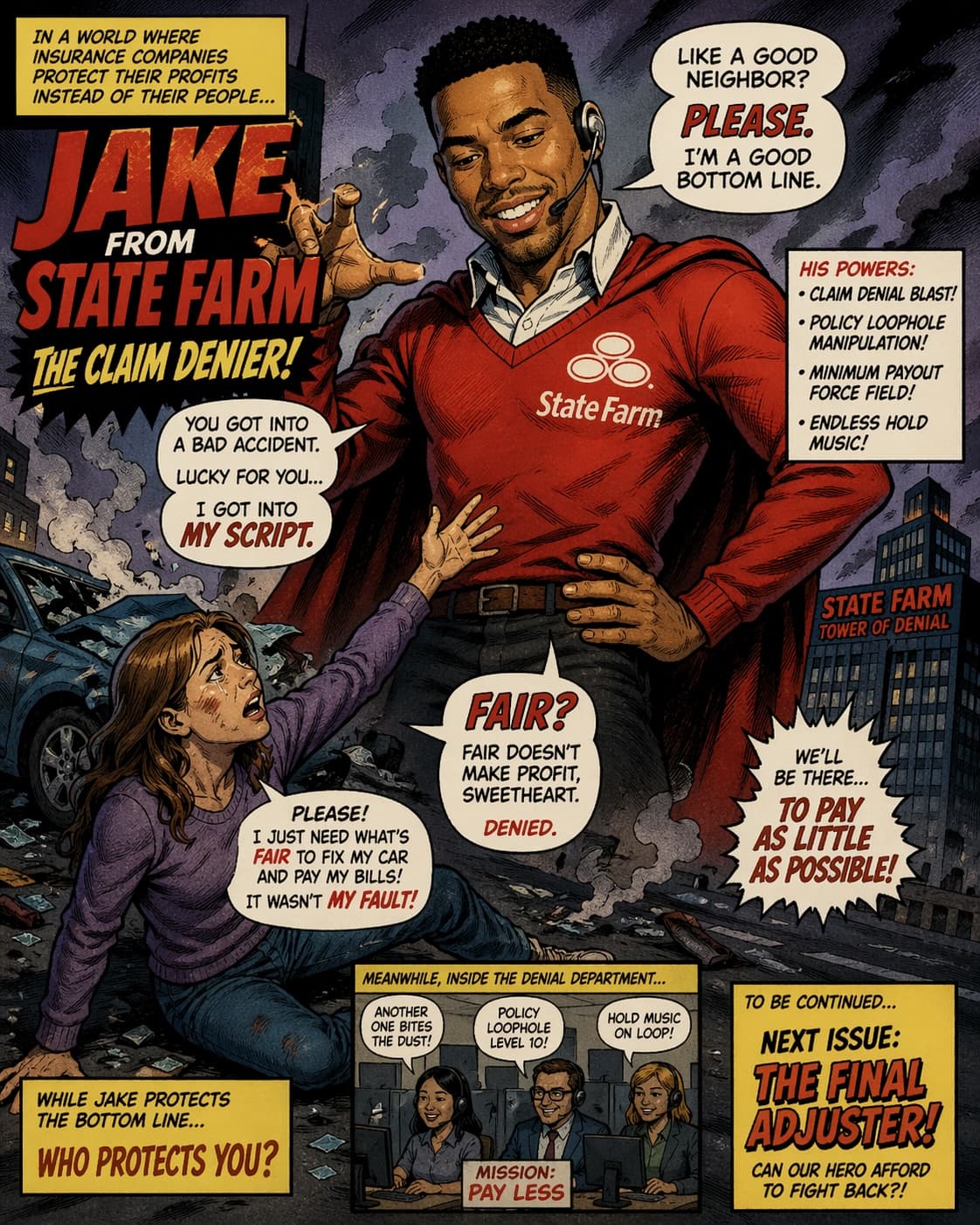
The Nightmare Scenario Nobody Warns You About
Picture this. You are sitting at a red light when someone rear-ends you at highway speed. It is not your fault. The other driver is cited at the scene. You are airlifted to the hospital with a fractured spine, a traumatic brain injury, and medical bills that start climbing toward six figures before you even leave the ICU.
Then comes the second gut-punch: the driver who hit you has no insurance.
This is exactly why you have been paying premiums for years on uninsured motorist coverage. Your agent told you it would step in and protect you if something like this ever happened. You file a claim with your own company. You trust them. And then your insurance company low-balls you.
What you may not realize is that Georgia law gives your insurance company almost no automatic financial incentive to treat you fairly.
Uninsured Motorist Coverage: What It Is Supposed to Do
Under O.C.G.A. § 33-7-11, every automobile insurance policy issued in Georgia must include uninsured motorist coverage unless you decline it in writing. The purpose is straightforward: it should put you in roughly the same position you would have occupied if the person who hurt you had carried adequate insurance.
Georgia also allows add-on UM coverage, meaning your UM limits can apply on top of whatever the at-fault driver's policy pays. In theory, it is a safety net that travels with you everywhere. In practice, the moment you make a serious UM claim, the safety net can start to feel like a negotiation with an adversary.
Add-On vs. Reduce-By Coverage: The Policy Language That Could Leave You With Nothing
Most Georgians who pay for uninsured motorist coverage assume it will step in and pay when the at-fault driver is uninsured or underinsured. What they may not know is that there are two fundamentally different types of UM coverage, and one can be almost worthless in common crash scenarios.
Add-on coverage does what most people think their UM policy does. If the at-fault driver has $25,000 in liability insurance and you have $100,000 in add-on UM coverage, the at-fault driver's policy can pay its $25,000 and your UM coverage can apply on top of that, giving you access to up to $125,000 total, capped by your actual losses.
Reduce-by coverage, sometimes called offset coverage, works differently. Instead of paying on top of the at-fault driver's policy, it only pays the difference between what the at-fault driver carries and your UM limits.
If you have $25,000 in reduce-by UM coverage and the driver who hit you carries Georgia's $25,000 minimum, their insurer pays $25,000. Your UM coverage pays the difference between $25,000 and $25,000, which is zero.
The fix is simple but costs more: buy add-on UM coverage and make sure your limits are high enough to matter. Check your declarations page. If it says offset or reduce-by, you may have coverage that provides far less protection than you think.
The Magic Trick: Your Insurance Company Disappears at Trial
When you file a lawsuit against an uninsured driver and serve your UM carrier, O.C.G.A. § 33-7-11(d) gives the insurance company a strategic choice. The insurer may appear as itself, as the tortfeasor, or as both. It can also choose to appear solely in the tortfeasor's name.
That means the jury may never learn that the company fighting you is your own insurer. The carrier hired defense counsel, directs the strategy, and controls the money, but legally it can vanish behind the tortfeasor's name.
This is not a bug. Georgia courts have blessed it as a way to avoid injecting insurance coverage into the trial. The practical result is that your insurer can fight you while hiding the fact that it is your insurer.
The Law That Should Help You, and the Loophole That Swallows It
Georgia's offer-of-settlement statute, O.C.G.A. § 9-11-68, is one of the most powerful tools in Georgia civil litigation. In an ordinary case, if a plaintiff makes a written settlement offer and later wins a verdict exceeding 125% of that offer, the defendant can owe the plaintiff's attorney's fees and litigation expenses from the date of rejection.
In ordinary injury cases, that creates real pressure to evaluate claims honestly. But UM cases are different. A 2025 Georgia Court of Appeals decision confirmed how badly that difference cuts against injured policyholders.
Blazys v. McKnight: The Case That Confirmed the Problem
Blazys v. McKnight, 377 Ga.App. 9, 921 S.E.2d 463 (2025)
Court of Appeals of Georgia | September 26, 2025
Injured motorists served their UM carrier with a § 9-11-68 offer. The carrier ignored it, then elected to proceed at trial solely in the tortfeasor's name. The jury returned a verdict more than 125% above the offer. The Court of Appeals held the carrier owed zero attorney's fees under § 9-11-68 because it was no longer a named party at the time of the verdict.
Joseph and Romaine Blazys were hit head-on by a driver named McKnight. They served their UM carrier, Allstate, with the lawsuit. Allstate initially answered in its own name and participated in discovery as a named party.
The Blazys family made Allstate a formal § 9-11-68 offer of settlement within policy limits. Allstate did not respond. Before trial, Allstate elected to proceed solely in McKnight's name. The jury returned a combined verdict exceeding $1.55 million, vastly more than 125% of the offers Allstate had rejected.
The trial court denied the fee motion. The Court of Appeals affirmed. Its reasoning was direct: § 9-11-68 applies to parties, and once Allstate elected to proceed only in McKnight's name, it was no longer the named defendant at trial.
The court essentially said: you are right about the policy problem, but that is what the statute says. Fix it, legislature.
Why This Is an Open Invitation to Low-Ball
From the insurance company's perspective, the incentive structure explains the behavior. In a normal crash case, rejecting a reasonable offer can create major fee exposure. In a UM case, after Blazys, the carrier can often avoid that exposure by proceeding in the tortfeasor's name.
The UM Carrier's Financial Calculus in Georgia
- Pay full value? That money is gone permanently.
- Low-ball and the policyholder gives up? The company keeps the underpayment. This happens far more often than trials.
- Policyholder fights back? Elect to proceed in the tortfeasor's name and avoid § 9-11-68 fee exposure.
- Worst-case scenario? A harder, separate bad faith path under Georgia insurance statutes, including § 33-7-11(j), which requires a judgment first and a separate action later.
The result is a two-tiered system: one set of rules for ordinary defendants facing fee-shifting accountability, and a more forgiving set of rules for your own UM carrier when you need it most.
State Farm: A Case Study in Calculated Low-Balling
No examination of UM bad faith practices would be complete without a hard look at State Farm, the largest auto insurer in the United States, with roughly 19% of the market and over $73 billion in annual premiums. The evidence against State Farm is not anecdotal. It has been tested in court, confirmed by multiple state supreme courts, and acknowledged by the United States Supreme Court itself.
The PP&R Scheme. Beginning in 1979, State Farm implemented what it internally called Performance, Planning and Review, or PP&R. According to the Utah Supreme Court's findings in Campbell v. State Farm, this policy was created with the objective of using the claims-adjustment process as a profit center. The U.S. Supreme Court acknowledged evidence of a national scheme to meet fiscal goals by capping payouts company-wide. Critically, the scope of PP&R applied to both third-party and first-party claims, meaning it applied directly to UM and UIM coverage.
Former State Farm employees testified they were subjected to recurrent pressure to reduce payouts below fair value and, at times, to knowingly underpay claims. The scheme allegedly targeted people least likely to fight back, and litigation revealed systematic efforts to destroy internal claims-handling manuals.
The McKinsey Connection. From 2006 to 2008, State Farm reportedly paid McKinsey & Company $84 million for a claims-spend project known internally as CMSR. The project produced the Advanced Claims Excellence program, which State Farm leadership described as designed to cut claim expenses. In practice, cutting claim expenses means paying less on claims.
Dhyne v. State Farm Fire & Casualty Co., 188 S.W.3d 454 (Mo. 2006)
Missouri Supreme Court
State Farm told an injured policyholder her UM claim was not covered even after its own attorney had advised internally that coverage existed. The Missouri Supreme Court found sufficient evidence that State Farm willfully and without reasonable cause refused to pay the claim.
Samsky v. State Farm Mutual Automobile Insurance Co., 37 Cal.App.5th 517 (2019)
California Court of Appeal | Bad faith settlement: $450,000
State Farm initially offered $3,920 on a $100,000 UIM policy after the injured person had exhausted the at-fault driver's $15,000 coverage. The bad faith case later settled for $450,000.
Montana CSI Settlement (February 6, 2024)
Montana Commissioner of Securities and Insurance | Fine: $2,000,000
After a two-year examination, State Farm agreed it had inappropriately denied payment to auto accident claimants and underpaid drivers in accidents with its insureds. The remediation required review of more than 2,400 claims and additional payments to claimants.
Washington State UIM Vehicle-Valuation Verdict (2025)
Washington State | Jury verdict: $54.6 million
A Washington jury ordered State Farm to pay $54.6 million over alleged systematic undervaluation of vehicles in UIM property-damage claims. The dispute centered on valuation methods that allegedly underpaid policyholders on total-loss and damage claims.
Washington State Farm Personal Injury Denial Class Action Settlement
Washington State | Class action settlement
State Farm settled a Washington class action brought by policyholders who alleged the company systematically denied personal injury claims under their own policies. The settlement fits the broader documented pattern of hard first-party claim handling.
The pattern is not a string of isolated mistakes. It is the logical output of a system designed to maximize profit by minimizing claim payments, a system that has been running under various names and consultants since 1979.
Georgia: The Perfect Legal Environment for Low-Balling
This is not exclusively a State Farm problem. State Farm is the most documented because it has been the most litigated. But the incentive structure that enables this behavior in Georgia applies to every UM carrier operating in the state.
O.C.G.A. § 33-4-6 provides a general first-party bad faith penalty of up to 50% of the insurer's liability, or $5,000, whichever is greater, plus reasonable attorney's fees. It requires a proper written demand, a 60-day failure to pay, and a finding that the refusal was frivolous and unfounded.
O.C.G.A. § 33-7-11(j), the UM-specific bad faith provision, provides a penalty of up to 25% of the recovery, or $25,000, whichever is greater, plus attorney's fees. But it is available only in a separate action, brought only after the insured first obtains a judgment against the uninsured motorist in the underlying tort action.
Neither remedy creates the automatic, no-excuses financial exposure that § 9-11-68 creates in ordinary litigation. The result is a legal framework in which the rational financial choice for a UM insurer facing a serious claim is to low-ball it, fight it, and absorb whatever verdict comes, because the worst-case downside is bounded and many claimants never make it to trial.
What You Can Do
- Do not assume your insurance company is on your side. In a serious UM claim, your insurer's financial interest is directly opposed to yours.
- Document everything from the start. Every communication, every offer, every deadline. Both § 33-4-6 and § 33-7-11(j) require a formal written demand before bad faith penalties can attach.
- Know what bad faith means in Georgia. The standard is demanding: courts look for a frivolous and unfounded refusal to pay, not merely a low offer.
- Understand the § 33-7-11(j) path. The UM-specific bad faith remedy requires a judgment against the uninsured motorist first, then a separate action against the UM carrier.
- Hire a lawyer who knows this terrain. Georgia UM cases are technically complex and strategically different from ordinary crash claims.
The Bottom Line
You bought uninsured motorist coverage because you were told it would protect you if someone without insurance hurt you badly. In the most literal sense, that is true. But the system governing how that coverage gets paid is tilted against injured policyholders.
In Georgia, the offer-of-settlement statute has a loophole large enough for a UM carrier to drive through it. Carriers can low-ball claims, elect to hide behind the tortfeasor's name at trial, and face no § 9-11-68 fee-shifting consequences for doing so. The remedies that remain are narrower and harder to use.
The court in Blazys v. McKnight acknowledged the problem plainly. The Georgia legislature knows about it. Whether they act is a political question. In the meantime, the financial incentive for every UM insurer operating in Georgia, State Farm included, is to pay as little as possible and bet that you will not fight back hard enough to make it matter.
Knowing that is not just useful information. In a serious UM claim, it may be the most important thing you know.
Cases and Statutes Cited
- Blazys v. McKnight, 377 Ga.App. 9, 921 S.E.2d 463 (Ga. Ct. App. 2025)
- State Farm Mut. Auto. Ins. Co. v. Campbell, 538 U.S. 408 (2003)
- Campbell v. State Farm Mut. Auto. Ins. Co., 2001 UT 89, 65 P.3d 1134
- Dhyne v. State Farm Fire & Cas. Co., 188 S.W.3d 454 (Mo. banc 2006)
- Samsky v. State Farm Mut. Auto. Ins. Co., 37 Cal.App.5th 517 (2019)
- O.C.G.A. § 33-7-11 — Georgia Uninsured Motorist Statute
- O.C.G.A. § 9-11-68 — Georgia Offer of Settlement Statute
- O.C.G.A. § 33-4-6 — Georgia Insurance Bad Faith Statute
- Montana CSI State Farm Settlement Press Release
- The Insurer — Court Orders State Farm to Pay $54.6 Million Over Vehicle Valuations
- Top Class Actions — Washington State Farm Personal Injury Denial Class Action Settlement
- Property Insurance Coverage Law Blog — State Farm Paid McKinsey $84 Million
- Jay M. Feinman, Delay, Deny, Defend
- State Farm 2025 Annual Report
Disclaimer: This article is for general informational purposes only and does not constitute legal advice. Laws and precedents change. If you have been injured in a crash involving an uninsured or underinsured driver, consult a licensed Georgia attorney about your specific rights and options.